
What changed, and what it means for a housing search
Every property manager and tenant in Tarrant County felt the shift when the eviction laws were updated this year.
Understanding the texas sb 38 eviction changes renters face today requires looking at Chapter 24 of the Texas Property Code. This legislation prompted the Texas Supreme Court to completely rewrite Rule 510 of the Texas Rules of Civil Procedure, setting strict new timelines.
We are licensed real estate agents, not attorneys, so our focus is purely on the housing reality you face.
I will break down the specific court updates below and then detail the strategies required for your immediate move-in placement. If you require legal advice, contact Legal Aid of NorthWest Texas or a qualified attorney.

The main provisions
The specific sb 38 texas eviction 2026 mandates mean trials happen fast. Senator Paul Bettencourt authored this legislation to streamline court dockets, restricting the entire eviction process to a strict 21-day maximum from filing.
Our team closely monitors these rapid updates. The speed of the justice court leaves very little room for error.
- Notice to vacate for nonpayment: The law generally requires delinquency across two consecutive months. For a current-month-only delinquency, a landlord must first issue a “notice to pay rent or vacate,” introducing a limited right to cure the debt.
- Electronic notice is permitted: If your lease includes a specific clause, an email or a message through a resident portal is legally effective notice.
- Hearings cover possession only: The justice court solely decides who is entitled to the unit. The judge will not resolve unrelated disputes between the parties.
- Summary disposition applies: In cases where facts are undisputed, the court can issue a judgment without a full trial. This compresses the timeline even further.
- Filing venue remains strict: Cases must be filed in the justice of the peace precinct where the property sits. Tarrant County has eight precincts, and filing in the wrong one can result in immediate case dismissal and wasted court fees.
The timeline, memorized
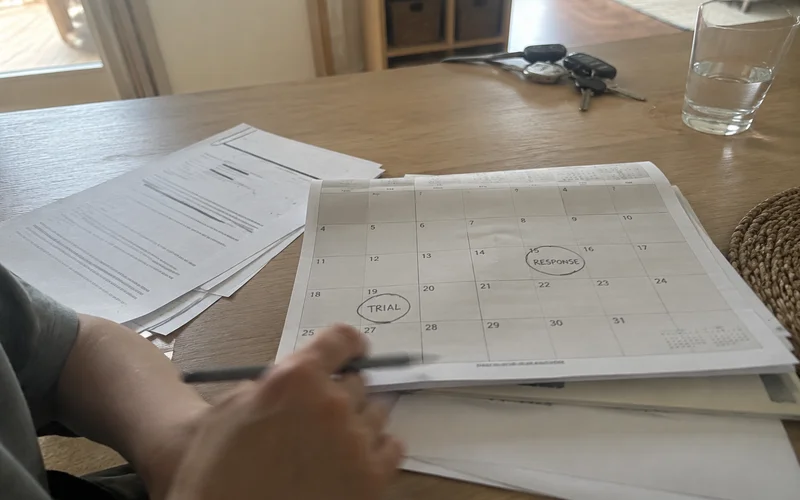
Trial 10 to 21 days after filing. Four days to respond. Five days to appeal. If you are searching for somewhere new, that is your entire runway.
Why the electronic notice provision matters most in practice
The electronic notice clause is the single most dangerous change for a tenant unaware of an impending filing. If a lease includes this provision, a simple message delivered through a resident portal application or to an email inbox legally starts the eviction clock.
We see this specific detail catch renters out every single week. Missing an email notification can cost you several days of an already shortened timeline without you knowing anything has started.
Many large management companies use software platforms like RealPage or Yardi for tenant communications. These automated systems often route critical legal notices directly to your email spam folder or send a quiet push notification to your phone.
Two practical steps are absolutely necessary right now:
- Check your lease: Look specifically for an electronic notice provision and verify which exact email address it names.
- Monitor the portals: Under the updated texas notice to vacate rules 2026, you must treat your inbox and property management app as urgent, certified mail if you fall behind on rent.
What the timeline means for a search
A standard apartment search simply cannot survive the new 21-day timeline imposed by a rule 510 trcp eviction. You must approach your housing hunt with documents pre-assembled and criteria verified from day one.
Our clients often assume they have a full month to secure a new lease. The reality of the justice court schedule proves otherwise.
Tarrant County Constables now operate under a strict five-business-day window to serve citations. The clock starts ticking the moment those papers hit your door.
| Stage | Typical timing | What a renter should be doing |
|---|---|---|
| Notice to vacate | Before filing | Assemble documents; start the search now |
| Filing | Day 0 | Confirm the precinct and the trial date |
| Response window | 4 days | Legal question, contact Legal Aid or an attorney |
| Trial | 10 to 21 days after filing | Search should already be well advanced |
| Appeal window | 5 days | Legal question, not a housing one |
The column on the right highlights the critical takeaway. There is no version of this scenario where a three-week search with a couple of application denials finishes in time. It has to be document-first and criteria-pre-screened immediately, which is exactly the process a same-week apartment search maps out day by day.
What SB 38 did not change
The legislation completely ignored two major factors that dictate your future housing outcome. The public nature of the filing and the private screening criteria of future landlords remain identical to previous years.
We focus heavily on these unchanged elements because they block more applications than anything else. Understanding these permanent roadblocks will save you hundreds of dollars in application fees.
Texas eviction filings are still public from the day of filing and still never expire. Data mining companies and tenant screening services like CoreLogic scrape Tarrant County court records almost instantly. The court record sits there permanently regardless of how the case ends. A dedicated guide covers How long an eviction stays on your record in Texas and explains exactly what that means when you apply somewhere new.
Screening criteria are still set entirely by each property. Lookback windows, balance policies, income multiples, and background rules are entirely private business decisions. No legislative change touched them.
A community manager evaluates several unchanged factors:
- Filing age: A community that counted a filing against you for five years in December counts it for five years right now.
- Financial requirements: Properties still demand gross income that equals three times the monthly rent.
- Debt histories: Outstanding balances owed to previous properties will almost always result in an automatic denial.
Where to go for the legal side
For civil legal matters in Tarrant County, eligible residents should contact Legal Aid of NorthWest Texas directly. An attorney can advise you on your specific case, a legal response, or a potential appeal.
The specific justice of the peace court handling your case, such as Tarrant County JP Court 7, can provide critical information. Calling the court clerk is the fastest way to verify your status.
You should always call to confirm these three details:
- Your exact hearing date and time.
- The specific precinct location and courtroom number.
- The list of documents currently on file from your landlord.
We do not handle any legal representation or court filings. What we do is execute the aggressive housing search that must happen concurrently.
Our goal is to find local communities whose criteria already permit your specific public record. This critical search must fit inside that tight 10 to 21 day window, so start organizing your pay stubs and identification today, and reach out if you need immediate placement assistance before your trial date arrives.