
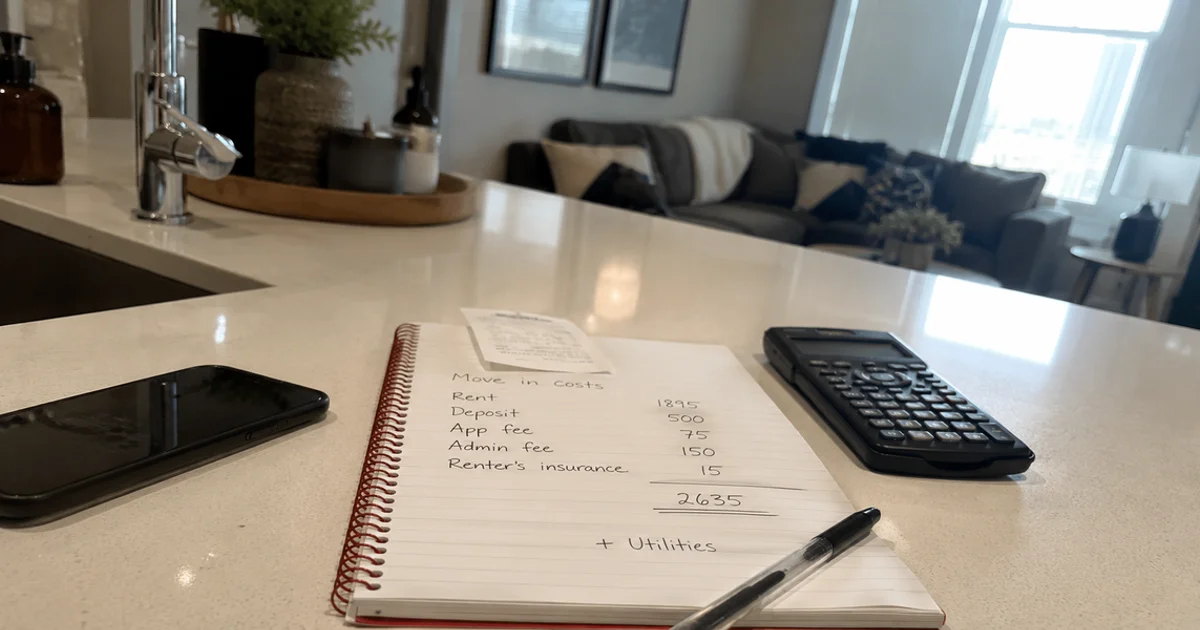
The number that collapses deals
Our team often sees a common misconception when advising homeowners transitioning to a rental or business owners relocating employees. Approval is rarely the actual finish line.
The true hurdle is the lease desk, where a surprising number of placements fall apart. This happens because the total cost to move into an apartment with bad credit is often thousands of dollars higher than standard budgeting allows.
The upfront move-in figure is an entirely different animal.
Fort Worth apartments average roughly $1,438 a month heading into 2026, which is what most people budget against. Getting the entire financial picture named upfront is a core part of second chance apartment locating. This upfront clarity is completely doable before you ever schedule a physical tour by reviewing:
- Mandatory line-by-line fees.
- Three real-world cost scenarios.
Line by line
Our process starts with identifying the mandatory upfront charges that hit before you even get keys. Business owners securing corporate housing or individuals relocating must track these closely.
- Application fee ($40 to $85 per adult): This non-refundable fee is charged per adult applicant regardless of approval. Two adults applying to three properties rapidly generates up to $510 in sunk costs.
- Administrative fee ($100 to $250): Most communities charge this once at approval. You should always ask if they waive this fee during a new building lease-up push.
- Pet fees: Expect $200 to $500 in non-refundable charges per pet. This often accompanies a $20 to $50 monthly pet rent.
- Renters insurance ($10 to $25 a month): Most Texas leases require an active policy before they release the keys.
Properties add specific surcharges when approving an applicant with a weak credit profile. These risk-based fees heavily impact your total apartment move in costs texas.
- Security deposit ($0 to 2x rent): A clean file might only require a few hundred dollars. A conditional approval commonly doubles it. Texas Property Code Chapter 92 has no statutory cap on security deposits, meaning a $1,438 unit can easily demand a $2,876 cash deposit. Landlords must legally refund this within 30 days of move-out.
- Risk fee apartment charge ($0 to $750): Some conditional approvals use a monthly charge or a flat non-refundable fee instead of a larger deposit. Properties across Dallas-Fort Worth frequently charge a flat $250 to $750 non-refundable credit risk fee upfront for scores under 600. At $50 a month, a recurring fee adds $600 over a year.
- Guarantor premium (roughly one month’s rent): Institutional guarantors like The Guarantors or Leap price this non-refundable premium as a percentage of annual rent. A $1,438 unit typically requires a $1,438 one-time payment.
- Deposit alternative (10% to 15% of the standard deposit): Surety bond products like Jetty or Rhino replace a massive cash deposit with a smaller non-refundable premium. Obligo uses a similar bank authorization model.
- First month’s rent: You must pay the full standard amount. Mid-month move-ins are prorated.
Three worked scenarios
Assume a $1,438 one-bedroom unit with one adult applicant and no pets.
| Line item | Clean approval | Conditional (double deposit) | Guarantee route |
|---|---|---|---|
| Application fee | $60 | $60 | $60 |
| Admin fee | $150 | $150 | $150 |
| Security deposit | $400 | $2,876 | $0 to $400 |
| Guarantor premium | $0 | $0 | $1,438 |
| Risk fee (first month) | $0 | $50 | $0 |
| First month’s rent | $1,438 | $1,438 | $1,438 |
| Cash at signing | approx. $2,048 | approx. $4,574 | approx. $3,086 to $3,486 |
Two distinct facts jump out from this 2026 data. First, the gap between a clean approval and a conditional one exceeds $2,500. Knowing your criteria position in advance saves real money.
Second, the guarantee route frequently lands below the double deposit apartment cost. It also opens up community inventory that a doubled deposit cannot access.
We see this comparison become the deciding factor for most renters. The breakdown of deposit alternative vs guarantor vs larger deposit works through these exact math differences in detail.
Refundable is not the same as cheap
A doubled deposit is refundable at the end of the lease. That sounds better than paying a non-refundable premium, but it locks up $2,876 you cannot use for twelve months. Deductions at move-out for cleaning or repairs remain very common. Paying a non-refundable $1,438 premium that you never had to find in cash represents a completely different kind of expensive.
Where the premium comes from
The guarantee premium is the line item renters most often meet for the first time at signing. It is the one cost most worth understanding early in your search.
This one-time fee typically costs around one month of rent. It buys a legal promise to cover the rent, letting a property approve a file that previously failed its screening.
Our team wants to clarify two critical misunderstandings about this product.
- It is not insurance: If you stop paying, companies like Leap or The Guarantors pay the property and then legally pursue you for the balance.
- It is not an approval guarantee: The property management company still makes the final decision on your file.
The guide on What a guarantor program costs covers renewal treatment and refundability. Both of these specific policy details routinely catch people off guard.
Concessions, and the renewal cliff
During a new building lease-up phase, temporary concessions can wipe out a large part of these initial expenses. Six weeks free on a $1,590 two-bedroom unit provides about $2,200 of actual value. Admin fees and initial deposits frequently drop at the exact same time.
That represents real savings for a transitioning homeowner or a business tightening its relocation budget. It remains the strongest argument for timing a move against an open lease-up window. The hidden catch always arrives at renewal, creating what industry professionals call the renewal cliff.
A concession spread across a twelve-month term produces a net effective rent well below the actual face rate. Your rent automatically jumps back up to the face rate at renewal time.
- Face Rate: The actual monthly price on the lease contract ($1,590).
- Net Effective Rate: The mathematical average you pay after applying the six weeks free ($1,406).
- The Renewal Jump: The sudden $184 monthly increase you face in year two.
We warn every client to prepare for this specific mathematical trap. You must budget for that higher face rate from the exact day you sign the lease.
What is not on this list
Our fee is completely missing from this breakdown because we do not charge one. There is zero cost to you for the consultation, criteria research, document preparation, property tours, or lease review.
The apartment community pays a referral fee from their standard marketing budget after the lease is signed and you take occupancy. Your rent never increases to cover this service. Every recommendation includes its own customized version of the financial table above.
- Accurate Unit Data: You will see the actual figures for a specific unit rather than generic ranges.
- Independent Planning: You can also run your own customized estimate using our renter tools before you talk to anyone on our staff.
- Regional Accuracy: The ranges provided here are typical for Tarrant County and the wider Texas market as of 2026.
They will naturally vary by property, specific unit, and the current season. We must emphasize that none of this data constitutes an approval decision or an offer of housing.
The community management always decides who gets approved. Knowing the total move-in number in advance simply means the final decision does not arrive as a financial shock. Contact our office today to start planning your relocation strategy.